

Project at a glance
The MODABAT project aims to develop an airworthy battery system for an ultra-efficient regional aircraft with a hybrid-electric propulsion system, targeted for entry into service by 2035.
Given the rapid evolution of various battery technologies (e.g. Lithium-Ion, Solid-State, Sodium-Ion), it is currently uncertain which technology will be suitable for aircraft integration. Therefore, a modular, scalable, and technology-open battery system design approach is proposed to align with the ambitious timeline and evolving technological landscape of the aviation sector.
Expected results include a certifiable aviation battery system design that is technology-open, along with a TRL4 battery system demonstrator based on COTS cells to verify safety and aircraft integrability. A comprehensive roadmap towards a TRL5 aviation battery system and flight-test readiness by 2030 will identify compliance pathways, potential obstacles, and mitigation strategies. Additionally, a digital twin of the battery system will leverage high-fidelity models of next-generation solid-state battery cells, integrated into the HERA REG DT framework, to validate the design’s suitability for intended aircraft applications.
The project will benefit the entire supply chain, from cell manufacturers to airframers, as well as certification authorities, research and technology organizations (RTOs), and academia. The impact of enabling the hybrid-electric regional aircraft’s entry into service by 2035 will enhance the global competitiveness of the European aviation industry while opening new markets for battery cell and system component suppliers. Furthermore, it will prepare certification authorities for the demands of future electric aircraft propulsion systems.
Ultimately, the societal benefits include reduced CO2 and noise emissions from air travel, ensuring that it remains affordable in the long term.

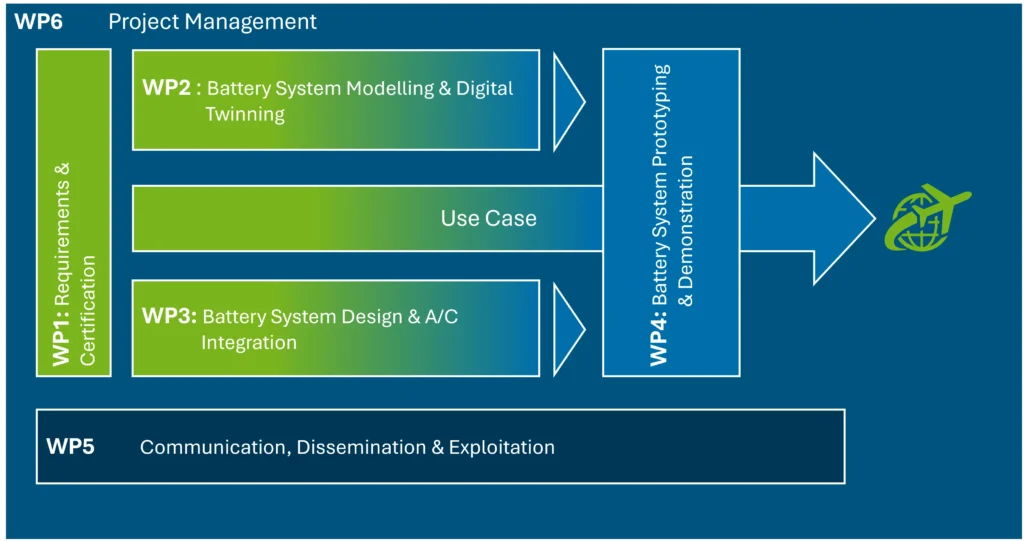
WP1
Requirements & Certification
WP1 focuses on defining, gathering, and managing the requirements that guide the entire project. It also establishes the means of compliance needed to progress toward certification, flight testing, and entry-into-service goals.
Battery System Modelling
& Digital Twinning
WP2 develops digital twin models for both baseline and solid-state battery cells, evaluates them under defined conditions, and uses the results to simulate electrical, thermal, and mechanical behavior. It also supports system optimization, forecasting, and diagnostics, providing design recommendations based on performance benchmarking.
WP2
WP3
Battery System Design
& A/C Integration
WP3 aims to develop safe, technology-agnostic, and certifiable battery system solutions for aircraft applications, designed to remain scalable as future battery cell technologies evolve. To achieve a complete aircraft battery system overview, WP3 focuses on designing and developing all key subcomponents—including the PDU, battery module and thermal management, enclosure and BTR handling, and the BMS—which will later be built and integrated into a demonstrator system in WP4.
Battery System Prototyping
& Demonstration
WP4 focuses on manufacturing a fully functional Battery Energy Storage System (BESS) and providing experimental evidence that the final design achieves TRL 4 and meets the targeted performance requirements. In addition, WP4 will conduct a comprehensive evaluation of the developed battery system to deliver guidelines for progression toward higher TRLs.
WP4
WP5
Communication, Dissemination
& Exploitation
WP5 will promote MODABAT innovations through targeted communication and dissemination activities, support the exploitation and market uptake of key results, contribute to standardization efforts, and ensure open access to project outcomes for the scientific community.
Project Management
WP6 ensures that the project remains aligned with Clean Aviation objectives and delivers maximum impact for both participants and the wider European community. It manages all contractual, technical, administrative, and financial aspects of the project, including the Grant and Consortium Agreements. WP6 also oversees the timely execution of the work plan, monitors progress, milestones, and risks, coordinates communication within the consortium and with the European Commission, and ensures full compliance with all legal, ethical, and security requirements.